An AI assistant that tidies interview notes and one that selects audit exceptions may look identical on screen. The consequences of relying on them are different.
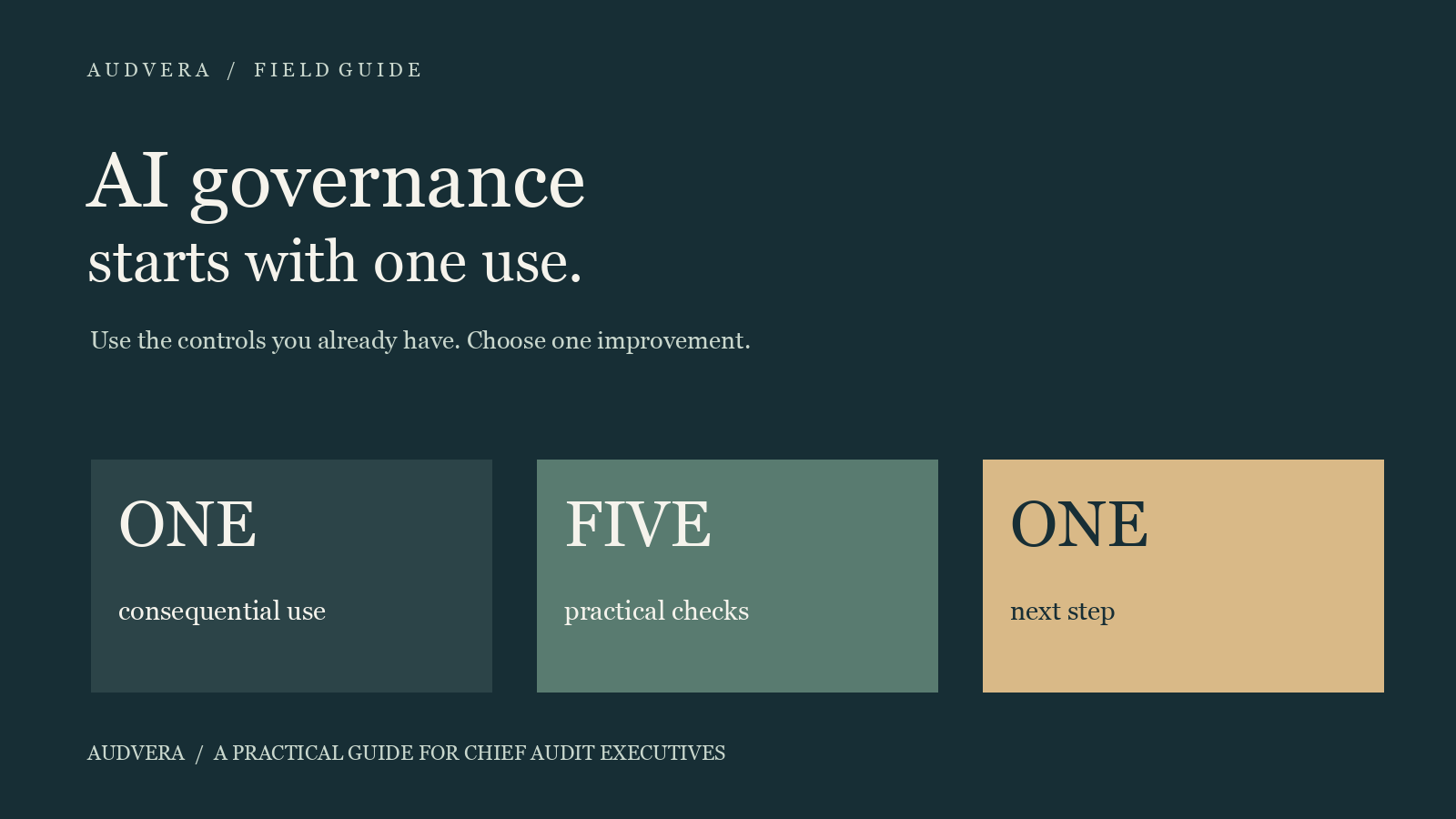
Match governance to what AI can influence or change. Start with the work that matters most, use the controls you already have, and choose one improvement.
This guide focuses on internal audit’s own use of AI. Assessing management’s enterprise AI is a separate assurance responsibility. The maturity descriptions and quick check below are Audvera’s discussion aids, informed by IIA, COSO, NIST and ISO guidance. They are not an official rating or a conformance assessment.
1. Start with what the AI does
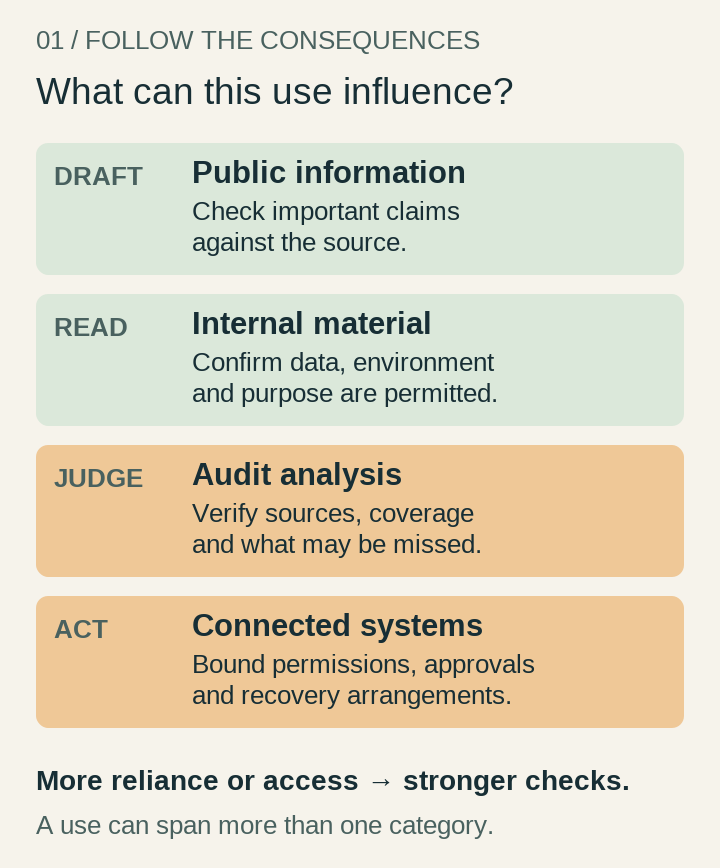
A use can cross categories. A public-source summary used to support a material finding needs more scrutiny than a brainstorming draft. An assistant that sends a request or changes a workpaper introduces action permissions and recovery questions.
For a first discussion, pick the use with the greatest potential to affect an audit judgment, expose sensitive information, or change a record. You can expand the discussion later.
2. Use maturity as a conversation
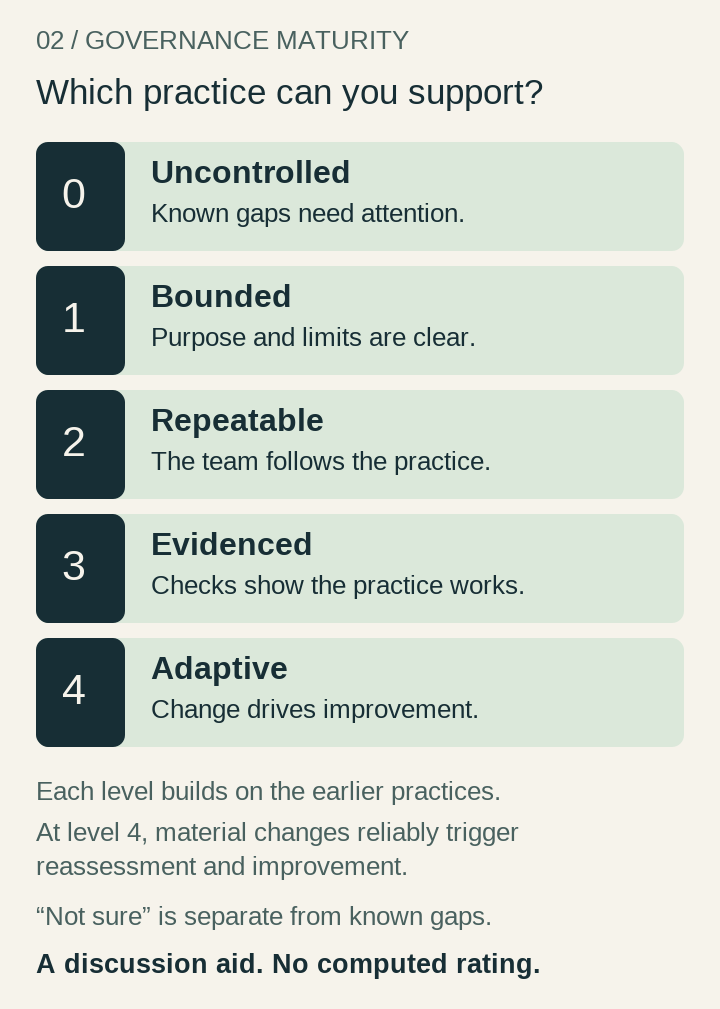
Ask which description you can support for this use. An existing policy, supervisory review or test result may already provide the basis. Higher levels build on the earlier practices.
You do not need to score six dimensions, calculate an average, or create a new evidence register. Keep any records your methodology and applicable standards require. The description helps the team identify the next useful improvement; it does not approve use or establish that controls are effective.
A function can choose narrow AI use and govern it well. More automation does not establish greater maturity.
3. The same tool can need different checks
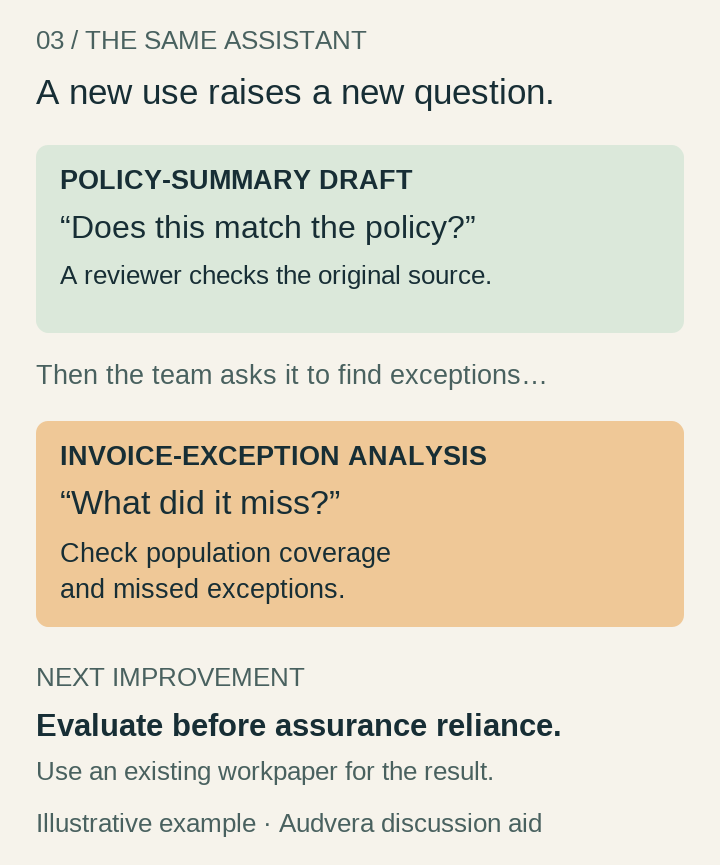
In this hypothetical example, the team has an approved environment and a reviewer who checks summaries against the policy. It then asks the assistant to identify exceptions in invoice data.
That second use raises a new question: what did the assistant miss? Reviewing the exceptions it found cannot, by itself, demonstrate complete processing or adequate detection.
The next improvement is a controlled evaluation: reconcile the processed population, include known exceptions and normal items, examine omissions, and agree how the results may be used. Document the procedure, source and verification in the existing workpaper so another qualified auditor can follow the work. The AI output alone does not establish the audit conclusion.
4. Try a ten-minute team discussion
Open the CAE AI Governance Quick Check
The ten minutes is a suggested starting time, not a promise that complex uses can be assessed that quickly. Pick one actual use, then discuss five questions:
- Purpose: Do we know who owns this use and what it is allowed to influence?
- Data: Are the information and environment approved for this purpose?
- Review: Is the output verified by a qualified auditor before consequential reliance or action, including material sources, coverage and limitations?
- Access: Does the assistant stay within permitted access and action limits, with approval and recovery arrangements where needed?
- Change: Will someone notice material changes or problems and know how to restrict, stop or escalate the use?
Answer Yes, Needs attention, or Not sure. The quick check points to discussion gaps. It does not compute maturity, give an approval, or validate the answers.
Choose one next step. For example:
Evaluate whether invoice analysis processes the complete population before relying on it for exception identification. The methodology lead will bring the result to the next engagement review.
Add the note to an existing meeting record or workpaper if useful. You do not need another dashboard, monthly submission, or parallel register. If a material safeguard is missing or uncertain, resolve it or restrict the affected use before relying on it; a short discussion is not a substitute for the assessment needed.
5. Let existing governance do the work
The sources supply different lenses:
- IIA: professional responsibility. Standards 5.2, 10.3, 12.3, 14.1 and 14.6 address information protection, technology, supervision, evidence and documentation. Simplifying this aid does not remove those obligations. Global Internal Audit Standards.
- COSO: connect the use to control ownership, design, operation and monitoring. Its GenAI guidance applies the existing internal-control framework to the capabilities being used. GenAI guidance.
- NIST: organize risk work through Govern, Map, Measure and Manage. The AI RMF is voluntary guidance; its GenAI Profile adds technology-specific risks. AI RMF 1.0 and GenAI Profile.
- ISO: connect to your organization’s AI management system where relevant. This guide uses the public overview, not detailed certification criteria. ISO/IEC 42001.
Use existing policy approvals, training, supervision, workpapers and quality reviews where they cover the actual use. If auditors help design management’s AI controls and later assess them, address the resulting objectivity risks under Standard 2.2. The IIA AI Auditing Framework provides a broader organizational perspective.
The next step: pick one consequential AI use, discuss the five questions, and agree one improvement. Revisit it when the use, data, access or technology materially changes, or within your existing quality-review routine.
Sources and method boundary
Primary documents were checked October 15, 2026; relevant official overview pages were rechecked October 16, 2026. The graphics, maturity descriptions, suggested discussion time and five-question method are Audvera’s design. They structure professional judgment and do not replace the applicable standards, organizational approvals or required engagement documentation.
Questions & answers
Is this an official maturity model?
No. The five descriptions and quick check are Audvera’s synthesis. The cited guidance informs the discussion; it does not endorse this aid or certify its result.
Do we need a separate AI governance register?
This aid does not require one. If your organization already keeps an AI use inventory, record the use there. Use existing records where they adequately cover the use and your obligations. A more complex use may need additional assessment and records; judge that from its risks and applicable requirements.
Does completing the quick check authorize AI use?
No. Answers are the team’s judgments. Approval remains with the appropriate authority, and unresolved safeguards need attention regardless of the answers or maturity description.
How do we track progress simply?
Return to the one improvement you agreed. Check whether it happened and whether the practice works. An existing engagement, methodology or quality review can hold the update; this aid adds no fixed reporting schedule.
Does higher maturity mean more autonomous AI?
No. The descriptions concern governance. A team can govern limited drafting well and decide that connected actions are inappropriate for its needs.
Can the quick check replace an audit or quality assessment?
No. It is a conversation aid for internal audit’s own AI use. It does not establish enterprise AI control effectiveness, legal compliance, IIA conformance or ISO certification.